84% of candidates now use AI tools when preparing applications or interview answers.
That figure may be striking, but the wider trend won’t be news to Early Careers teams.
What matters is what happens next. When more candidates can research, prepare and communicate well, what can you still confidently learn from the information in front of you, and where do the meaningful differences between candidates start to show?
Application volume and AI-assisted applications were among the biggest pressures identified by employers in our research.
Financial institutions also rated their confidence in current Early Careers assessment methods at just 55 out of 100 when it comes to predicting on-the-job performance.
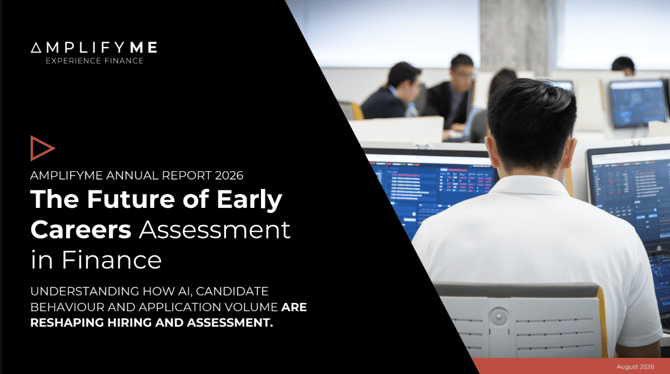
Our 2026 Annual Report: The Future of Early Careers Assessment in Finance looks at how graduate recruitment and assessment are changing, and what that means for employers.
Here are four areas we think are worth paying attention to.
1. AI is changing how employers differentiate candidates
Applications have always given employers a useful first view of a candidate’s experience, motivation and understanding of the opportunity. But AI is changing how much you can confidently read into that first impression.
With more tools available to support candidates as they research, prepare and refine their applications, a polished application may not separate candidates in quite the same way.
Our research points to a disconnect here. Students were significantly more likely to question CV screening and aptitude testing than practical or performance-based approaches, while only 22% said CVs and cover letters were where they could best demonstrate their true ability.

The more interesting differences may show up elsewhere. Take two candidates who reach a similar conclusion during an interview or case. One tests their assumptions, changes direction when new information emerges and can explain the thinking behind their decision. The other reaches the same answer.
The outcome might look similar. What you’ve learned about the two people is very different.
At scale, that raises an important question: where in your recruitment process do the differences that actually matter for the role become visible?
2. The AI question is shifting from whether candidates use it to how
As AI becomes more common at work, whether someone uses it is becoming less interesting than how they use it.
Give two people access to the same tool and you can still see very different behaviours. One might accept the first output they get. Another might question it, spot something that doesn’t look right, refine their approach or decide that their own judgement is better.
Those differences can tell you far more than whether someone used AI in the first place.
These are skills employers already value. Yet our research suggests candidates don’t always feel they get the chance to demonstrate them during recruitment. 45% said learning agility was overlooked, 42% adaptability and 40% practical problem-solving.
For employers, there’s an opportunity to look at where AI is likely to feature in the role and what good use of it would actually look like. Where should a graduate be able to use AI effectively, and where would you still expect them to challenge it, adapt or make the call themselves?
That gives you something more useful to look for than whether AI was used in the first place: how someone actually works with it.
3. Unrehearsed moments can tell you more
Some behaviours only really become visible when a candidate has to respond in the moment. Give someone new information, change the priorities or put a decision in front of them, and you start to see how they actually approach it.
Our research suggests candidates want more opportunities to show this too. 63% selected scenario-based problem-solving as one of the best ways to demonstrate their true ability, while 57% selected practical job simulations.
Employers pointed in a similar direction. In our industry polling, in-person interviews and role-specific simulations were identified as the strongest indicators of future performance among the methods included, ahead of CVs, aptitude tests and pre-recorded interviews.
That doesn’t mean making the process deliberately unpredictable. In the simulations we run with employers, the value comes from seeing how someone makes a decision, responds to new information or changes their approach when they need to.
You get to see more than how well someone has prepared. You see what they do with what they know.
4. The bigger question is what actually predicts performance
AI has brought new questions into recruitment, from where candidates should be allowed to use it to what, if anything, they should disclose. But there’s a bigger question behind all of that: how confident are you that your recruitment process is identifying the right people?
When we asked financial institutions how confident they were that their current Early Careers assessment methods predict on-the-job performance, the average was just 55 out of 100. Only 7% of students felt current recruitment processes measured their ability to perform in the job very accurately.

As some of the information employers have traditionally relied on becomes harder to interpret, understanding what actually relates to performance becomes even more important.
Some of that insight may already exist within the business. Looking back at your strongest graduate hires can help show which qualities were visible during recruitment, which turned out to matter once they started, and what hiring managers only discovered later.
Ultimately, the information you collect needs to help you make better decisions about who is most likely to perform.
Three questions to take back to your team
AI will keep changing how candidates prepare and the tools they have available. Rather than trying to keep pace with every new development, it may be more useful to look at what your recruitment process is actually telling you.
- What are we relying on most heavily when deciding who progresses, and what does that information actually tell us?
- Where do candidates get the chance to show us how they think, adapt and make decisions, rather than simply give us a prepared answer?
- Which of the things we measure during recruitment do we actually see reflected in performance once someone joins?
Want to see what this means for your Early Careers strategy?
Our 2026 Annual Report: The Future of Early Careers Assessment in Finance brings together insights from 750 students and recent graduates and 60+ employer and industry perspectives, alongside five priorities for the future of Early Careers assessment.
Explore the 2026 Annual Report, here.
And there’s more to come. Over the next few weeks, we’ll be unpacking more of what the research tells us about the future of Early Careers recruitment and assessment.


.png?width=329&height=214&name=Website%20Image%20Template%20(2).png)