
Imagine this: Two candidates achieve almost identical scores in a technical assessment. Both can code, both meet the requirements and both look equally strong on paper.
But put them in front of a market-based challenge and the differences start to emerge. One spots an opportunity and adapts as conditions change. The other takes a different approach to solving the same problem.
Both have demonstrated technical ability. But their scores only tell part of the story.
For Early Careers and Talent Acquisition teams, that creates a challenge. When hiring managers are reviewing shortlists, they need more than confirmation that candidates can code. They need evidence of how those skills translate into the work they're recruiting for.
The coding test may be complete. But has it told you enough?
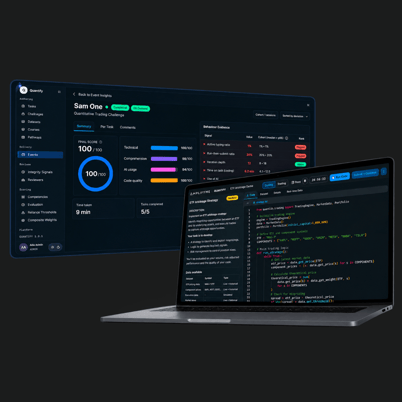
That's where Quantify, AmplifyME's quantitative assessment platform, comes in. Through practical, market-based challenges, it brings technical assessment closer to the realities of quantitative roles.
See how candidates respond when the market moves
A strong technical score tells you something about a candidate's ability. But applying those skills to a changing market presents a different challenge.
Consider a quantitative research team recruiting its next graduate intake.
In a market-based assessment, candidates work with market data, develop a trading strategy and test their approach in a simulated environment.
As market conditions change, they must consider new information, assess whether their strategy is still effective and decide how to respond.
It's a more practical test of their technical skills, bringing together coding, quantitative thinking and decision-making within a scenario relevant to the work.
For hiring teams, the value lies in seeing how candidates apply their skills to a problem that reflects the demands of the role, rather than simply whether they can produce working code.
Turn assessment results into better hiring conversations
Picture the shortlist review.
Your hiring manager has five candidates who have met the technical standard. They want to know who demonstrated the strongest skills for their team and why.
An overall score provides a starting point. But it may leave them wanting more detail.
A role-relevant challenge gives hiring teams a clearer basis for evaluating performance, helping them understand how candidates' solutions met the technical requirements of the task.
AI has changed what a strong technical assessment needs to tell you.
When candidates can use AI to support their work, producing a working solution is only part of the picture. Hiring teams also need to understand how candidates apply their own knowledge, judgement and technical skills.
Quantify brings AI into the assessment approach rather than treating it simply as something to prohibit, helping firms consider how AI fits into the capabilities they're looking to evaluate.
Instead of presenting a shortlist based largely on technical scores, you can discuss performance against the priorities agreed with the hiring team, including how AI fits into the skills being assessed.
The final decision still belongs to your hiring managers. But they have more relevant evidence to consider when making it.
One recruitment programme. Different business priorities.
You're responsible for delivering a consistent recruitment process across the business. But your quantitative research, trading and engineering teams aren't all looking for the same skills.
Each hiring manager has different expectations of what a strong candidate looks like, and your assessments need to reflect those priorities without creating a fragmented recruitment programme.
That's where firm-specific challenges make a difference.
By agreeing what each team needs to evaluate, you can build more relevant assessments around those requirements while maintaining a structured approach across your programme.
Your hiring managers get evidence that matters to them. You retain a consistent approach to recruitment.
Give candidates a better sense of the opportunity
Your recruitment process is often one of the first meaningful interactions candidates have with your organisation.
And the assessment itself can shape that impression.
For graduates considering quantitative careers, there's a difference between reading about a role and experiencing some of the challenges involved.
Someone studying mathematics, physics or computer science may have the technical foundations for a career in finance, but limited exposure to how those skills are used in a trading or research environment.
A practical, market-based challenge brings that work to life.
Candidates can apply their knowledge to a relevant problem and experience aspects of the role before joining. For your organisation, that means assessment becomes more than a way to evaluate technical ability. It's also a chance to introduce applicants to the work your teams do and give them a clearer picture of the opportunity they're considering.
Your next shortlist deserves more than a score
Your hiring managers know what they're looking for. Quantify helps bring those priorities into the assessment process through practical, firm-specific challenges.
See what Quantify could look like for your hiring teams.
Book a demonstration to explore how a more practical, role-relevant approach to assessment could support your quantitative recruitment programme.


